

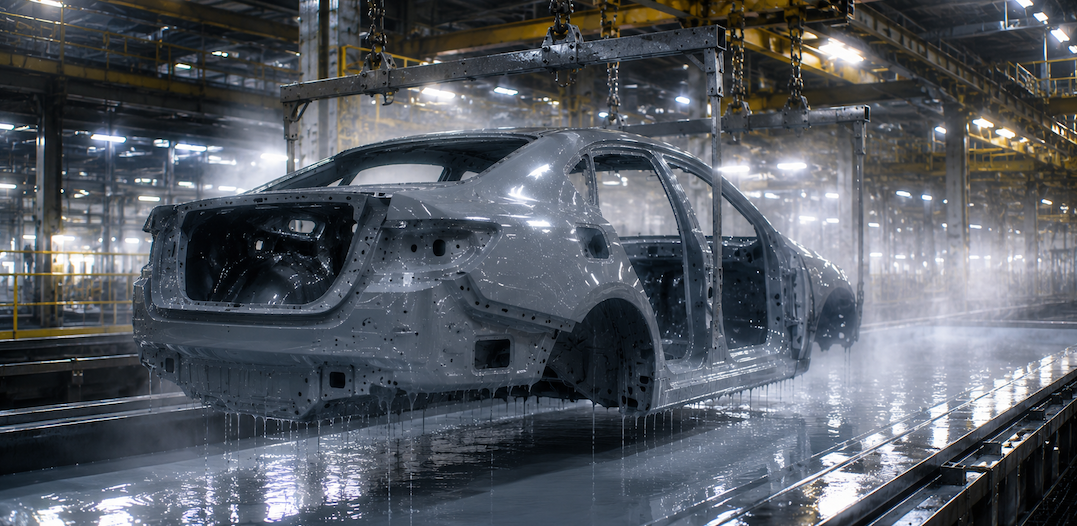
The paint on your vehicle sits on two factory primer layers. First, the e-coat (electrodeposition primer, or EDP — the dipped corrosion barrier in the image above). Then a primer surfacer sprayed over it that smooths the surface and tints it so your color reads correctly. Together they bond the paint to the body, block corrosion, and give your color the right foundation underneath.
This guide covers the four most common primer questions: whether your repair needs primer at all, what to do for repairs on large plastic parts, why the primer color underneath affects your final color match, and whether you can use primer from another brand.
Quick Reference
Your situation | What you need to figure out | Where to go |
|---|---|---|
Chip or scratch — not sure if it's deep enough to need primer | Whether your repair needs primer at all | |
Repair on a bumper, spoiler, mirror, or other plastic part with bare plastic showing | Whether you need adhesion promoter under primer | |
Color is bright red, orange, yellow, pearl, or tri-coat | Whether primer color affects your color match | |
Have leftover primer from another brand or supplier | Whether other-brand primer is compatible with our paint |
What Primer Actually Does in a Paint Repair
Primer isn't just "paint that goes on first." It does three jobs the paint + clear coat alone can't:
Bonds the paint to the substrate. Bare metal and bare plastic don't hold automotive paint reliably on their own. Primer chemically grips the substrate (with help from adhesion promoter on certain plastics) so the rest of the paint stack stays attached when the body flexes, heats up, or takes a knock.
Blocks corrosion. On metal substrates, primer seals the bare surface from moisture and oxygen so the steel underneath doesn't start rusting from the inside out.
Tints the surface to support the paint color. Automotive paint pigments are partly translucent — what's beneath the color affects how the color reads. The right primer tint gives your paint finish the foundation it needs to land on the right color.
Factory paint has all three jobs handled by the factory primer system applied at the assembly plant. When that factory primer is undisturbed beneath your repair, your touch-up paint bonds to it directly and you don't need new primer. When your repair goes deep enough to expose bare metal or plastic, primer rebuilds that foundation locally.
Do You Need Primer for Your Repair?
The deciding factor is depth. Look closely at the chip or scratch with a flashlight (your phone light is fine):
No bare metal or plastic visible — the factory primer is intact under your damage. Your touch-up paint goes directly over the existing primer; you don't need to add new primer.
Bare metal or plastic visible — the factory primer is gone in that spot. Apply primer before your base color so the paint has something to bond to and the color reads correctly.
This is the primer question most repairs come down to. The full answer, with photos and depth examples, is in When Should I Apply Primer?.
Working on a Plastic Part?
Most modern bumpers, spoilers, body cladding, fender flares, and mirror caps are made from a low-surface-energy plastic that paint can't bond to directly. For repairs where bare plastic is exposed across more than a small spot — including new replacement parts that arrive unpainted — you'll want adhesion promoter before primer. Adhesion promoter is a tie coat between bare plastic and the rest of your paint stack; without it on a meaningful area of bare plastic, paint can flake off the first time the part flexes.
For small spot repairs over intact factory primer on a plastic part, adhesion promoter usually isn't needed — the surrounding paint carries the bond.
When to Use Adhesion Promoter on Plastic Parts covers the question, the substrate prep, and the application steps.
Why the Primer Color Matters for the Color You See
Automotive pigments aren't fully opaque. Even at full coverage, some light passes through the topcoat, hits the surface beneath, and reflects back through the paint to your eye. The result: what's under your color affects how the color looks.
This effect is strongest for bright reds, oranges, yellows, pearl, and tri-coat colors — pigments that are physically more transparent. For these, using the recommended primer tint isn't optional for accurate match. Muted earth tones, beiges, and mid-grays hide better on their own and tolerate primer-color variation more.
The primer in every ScratchesHappen kit is selected to match your specific color formula, so this is handled for you when you order. The full explanation — with manufacturer references and a test-card visual — is in Why Primer Color Matters for Your Touch-Up Color Match.
Can I Use a Primer I Already Have from Another Brand?
Sometimes. Most automotive primers are formulated to be cross-compatible with most automotive base colors at the chemistry level — the risk usually isn't adhesion failure, it's color match. An other-brand primer in a different tint than the one your color formula calls for will shift the final color, especially for transparent pigments.
Can I Use Other-Brand Primers and Clears with Your Paint? covers when other-brand substitution is reasonable and when it's worth ordering matched product.
FAQ
Do I need primer if I don't see bare metal or plastic?
No. If the factory primer is still intact under your damage, your touch-up base color bonds directly to it and you don't need to add new primer. Primer is required when the damage exposes bare substrate.
What primer comes with my kit?
Bottle Complete and Preferred kits and Aerosol Complete and Preferred kits include color-matched primer selected for your specific color formula. The primer tint is paired to your color in the same way the factory pairs primer tint to paint color — based on what your color formula calls for.
The Essential kits don't include primer; if you discover during the repair that you do need it, you can order primer separately or contact Support for help selecting the right one.
What's the difference between primer and adhesion promoter?
They do different jobs and they go in different places. Adhesion promoter is a clear coat that bonds paint to bare plastic — it goes on the plastic, before primer. Primer sits over adhesion promoter (on plastic) or directly on bare metal, and gives your color paint a tinted, sandable base to go over. Plastic repairs that need adhesion promoter use both — adhesion promoter first, then primer. See When to Use Adhesion Promoter on Plastic Parts for when each is needed.
Does primer color matter even for small touch-ups?
For small spot repairs that build to full coverage with 2–3 thin coats, primer color matters less because the topcoat opacity narrows the difference. For bright reds, oranges, yellows, and pearl or tri-coat colors, primer tint affects the final color even at full coverage — the right primer is still the cleanest path to an accurate match. The primer your kit includes is selected for your specific color formula.