

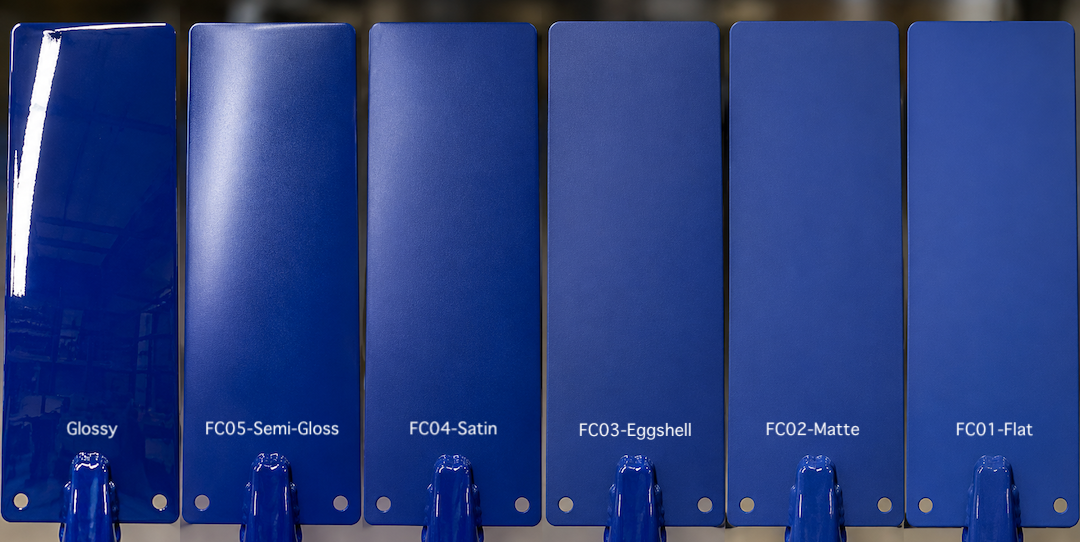
Most factory body panels are glossy. Matte clear coat is rare as a full-body finish (mostly motorcycles and select vehicle models). It may also show up on some bumpers or lower body cladding in satin or semi-gloss finish. Your kit ships with the right clear coat for your paint code automatically — gloss, or one of five matte levels (FC01 through FC05). One key application difference: the final coat of matte clear cannot be wet sanded — wet sanding polishes the matte surface to a gloss and eliminates the finish you're trying to preserve.
Quick Reference
Glossy clear coat | Matte clear coat | |
|---|---|---|
Found on | Most factory body panels | Uncommon — mostly motorcycles and select vehicle models; may also appear on some bumpers or cladding |
Levels | One | Five (FC01 flat → FC05 semi-gloss) |
Formulation | Waterborne | Solventborne |
Appearance in the bottle | Slightly milky / whitish | Clear, like water |
Appearance once cured | Fully transparent, glossy | Matches the factory matte level |
Wet sanding final clear coat | Allowed (per kit instructions) | No — turns the final coat of matte into gloss |
How you get the right one | Auto-included in your kit based on paint code | Auto-included in your kit based on paint code |
Where You'll Find Matte Clear Coat
Most factory body panels — hoods, doors, fenders — are glossy. Matte clear coat shows up in a couple places:
Full-body matte finishes, used on a few motorcycle models and select vehicle trims (some Lamborghini, Lexus, and Mercedes-Benz models). When a vehicle has a full-body matte finish, it's usually marketed prominently — owners typically know.
Some bumpers and lower body cladding may have a satin or semi-gloss finish even when the body panels are glossy. This isn't common — most bumpers are glossy too — but it does happen on certain vehicle models.
If you're unsure which clear coat your kit will include, contact Support with your paint code and the panel you're repairing — we'll confirm.
Five Levels of Matte
We use the PPG Envirobase paint system, which offers five matte levels — sold as FC01 through FC05 — calibrated to match factory matte finishes:
Level | Finish | Where you'll see it |
|---|---|---|
FC01 | Flat | Ultra-low gloss; select Lamborghini and Lexus models |
FC02 | Matte | Deep matte; few OEM coatings use this range |
FC03 | Eggshell | Subtle reduced gloss; Mercedes-Benz and other manufacturers |
FC04 | Satin | Can be found on some bumpers and lower body cladding |
FC05 | Semi-Gloss | Slightly higher sheen; also found on some bumpers and cladding |
You don't need to know which level your vehicle uses — the formula for your paint code calls for the right one, and your kit ships with that level automatically.
How Your Kit Is Matched
When you order an Essential, Preferred, or Complete kit, we use your paint code to look up the factory formula for your vehicle, including the gloss level for the panel you're repairing. Your kit ships with the matching clear coat — gloss or the appropriate matte level — without you needing to specify.
If you're ordering matte clear coat as a standalone product (separately from a kit), you'll select the level from FC01 through FC05 on the matte clear coat product page. Contact Support with your paint code if you'd like help confirming which matte level is correct for your paint code.
What the Liquid Looks Like in the Bottle
The clear coat in your kit may not look "clear" in the bottle — and that's normal.
Glossy clear coat is a waterborne formulation. Waterborne clears can look slightly milky or whitish in the bottle, but they dry fully transparent once applied.
Matte clear coats (FC01–FC05) are solventborne formulations. These typically appear clear in the bottle, like water, and dry to the correct matte or satin finish level.
The appearance of the liquid in the bottle does not affect the final clarity or finish once the clear coat cures.
The Wet-Sand Difference
Wet sanding the final clear coat is part of the standard repair process for glossy — sanding levels small imperfections in the cured clear, and polishing brings the finish back to gloss.
The same final-coat process turns a matte finish into a glossy one. The mechanical action of wet sanding and polishing smooths the microscopic surface texture that gives matte its diffused look.
Skip wet sanding and polishing on the final coat of matte clear repairs — your kit instructions will reflect this, but it's worth knowing in advance if you're new to working with matte clear. Wet sanding lightly between coats to remove a dust nib is a different case — see the FAQ below.
FAQ
How do I know if my vehicle has matte clear coat?
Almost all factory clear coats are glossy. Matte is uncommon — used on a few motorcycle models and a small number of vehicle trims, usually as a prominently-marketed feature. If your vehicle has a full-body matte finish, you'll most likely have known when you bought it. Some bumpers or cladding panels also use a satin or semi-gloss matte clear, though this is less common. If you're unsure about your specific vehicle or panel, contact Support with your paint code and we'll confirm.
Why does my gloss clear coat look milky in the bottle?
Because it's a waterborne formulation. Waterborne clears commonly look slightly milky or whitish in the bottle and dry fully transparent on the panel. The liquid appearance doesn't predict the final finish.
Why does my matte clear coat look like water in the bottle?
Because it's a solventborne formulation, which is typically clear-looking in the bottle. It dries to the matte or satin finish level called for by your paint code formula.
Can I wet sand between coats of matte clear coat?
Between coats, yes. Light wet sanding between coats, sometimes called "de-nibbing," is a technique for removing dust nibs or small imperfections that landed in the clear coat during application.
Wait for the coat to cure enough to sand (typically several hours, depending on conditions), then use a fine grit (1000–1500 wet) with a light touch — just enough to level the imperfection. Wipe clean and continue with your next matte clear coat over the smoothed surface. The technique applies between coats only; the final coat is not wet sanded or polished, since that would remove the matte texture.
Why can't the final coat of matte clear be wet sanded and polished?
The matte appearance comes from microscopic surface texture that scatters light. Wet sanding mechanically smooths that texture, which polishes the surface to a gloss. There isn't a way to wet sand or polish the final coat of matte clear without losing the matte finish, so wet sanding and polishing is skipped entirely on the last coat of matte clear.
Can I mix glossy and matte clear coat?
No — they're different formulations (waterborne and solventborne) and aren't intended to be mixed. Your kit will include just the level your formula calls for.
Will my matte repair exactly match the surrounding panel?
If your kit's matte level (FC01–FC05) matches your factory finish — which is what the paint-code formula determines — the gloss level should match.
Always paint a test card to verify your color and finish match first. If the painted test card finish doesn't match your vehicle, contact us in Support, and pause the repair.
Can a vehicle with a matte finish go through a machine car wash?
No. The brushes in a machine car wash will polish the matte finish to a gloss.
Can I switch the finish on my repair from glossy to matte (or vice versa)?
Generally no — these are different products and your kit ships with the level matched to your factory finish. If you have a specific reason to want a different gloss level (a custom project, an intentional refinish), contact Support to discuss what's possible.