

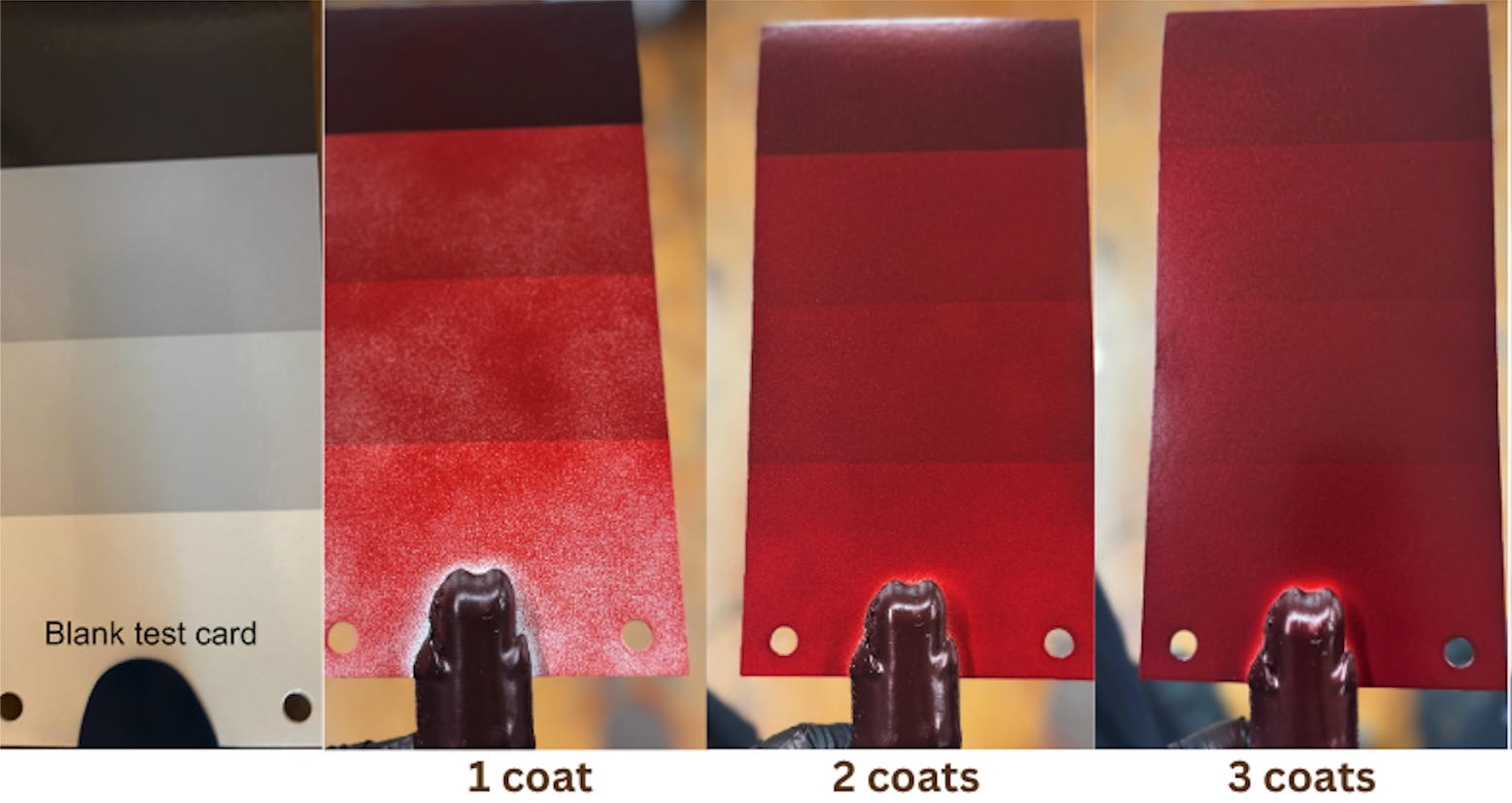
The primer color underneath your touch-up paint affects the final color because most automotive paints let some light reach the surface beneath them. This is especially true for bright reds, oranges, and yellows — pigments that are more transparent by nature — and for pearl, metallic, and tri-coat finishes. Major automotive paint manufacturers including PPG, Axalta, and Sherwin-Williams all publish primer-tint systems that map each paint color to a specific recommended undercoat / primer.
ScratchesHappen primers are tinted to those manufacturer specifications — so if your repair needs primer, the primer that ships with your color is the one your paint formula calls for. If you're not sure which primer your paint needs, contact Support and we'll confirm.
Quick Reference
Paint color category | Primer tint typical | Why |
|---|---|---|
Light colors (whites, pearl whites, light beiges, pale silvers) | White primer | Keeps light colors reading bright; gray or dark primer would dull them |
Medium colors (most blues, greens, mid-grays, mid-reds, browns) | Medium gray primer | Keeps a standard balance for most factory colors |
Dark colors (black, charcoal, dark blue, dark gray) | Black primer | Prevents dark colors from looking lighter than intended |
Bright translucent colors (bright reds, oranges, yellows, candy and tri-coat finishes) | Varies depending on paint formula | These pigments are most affected by undercoat; the formula specifies which tint |
The specific primer for your color is determined by the paint formula, not by visual estimation. We pair primer to color when we ship — the table above is for context.
Why Primer Color Affects the Final Result
Automotive paint pigments aren't fully opaque. Even at recommended thickness, some light passes through the top coats of paint, hits the surface beneath, and reflects back through the paint to your eye. The color you see is a mix of the pigments in the paint and what's reflected from the layers underneath.
The strength of that effect depends on the pigment. Bright, clean yellows, oranges, reds and some blues use pigments that are physically more transparent than muted earth tones — they let more light through to the surface beneath. Muted, grayed-off, or earth-tone colors are more opaque on their own — they hide the underlying surface in fewer coats, and primer color matters less.
The image at the top of this article shows the effect on a test card: the same red paint sprayed at 1, 2, and 3 coats over a banded card (white through black). At one coat, the underlying primer reads strongly through the paint — the white-band area looks pink-red, the black-band area looks deep maroon. By three coats, the paint has built enough opacity that the differences narrow, but they don't disappear. The primer beneath is still influencing the final color.
How ScratchesHappen Maps Primer to Each Color
ScratchesHappen primers follow PPG's primer-tint mapping. PPG's automotive refinish system uses a series of gray shades called Spectral Gray (SG) — seven shades, G1 through G7 — with each color formula in PPG's database specifying which gray shade is recommended underneath. PPG's technical literature on translucent OEM finishes asserts that "an SG undercoat contributes to the final base coat color" — meaning the undercoat (primer) is not a passive sealing layer beneath the paint color, but an active contributor to how the color reads on the finished panel.
We map PPG's G1–G7 to our three primer colors:
G1–G2 → ScratchesHappen white primer
G3–G5 → ScratchesHappen medium gray primer
G6–G7 → ScratchesHappen black primer
When you order paint, the primer that ships in your kit is selected based on the Spectral Gray shade specified by the color formula in PPG's database — not a generic universal gray. PPG's published guidance for collision repair technicians has moved away from the older approach of applying paint to full visual coverage for translucent OEM colors; current PPG technique is to spray to perceived hiding over the recommended gray undercoat, allowing the undercoat to contribute to the final color in the way the factory paint formula intends. The principle — that translucent topcoats (color) let light interact with the surface beneath — is well-documented across major automotive paint manufacturers, with Axalta and Sherwin-Williams publishing parallel primer-tint systems mapped to their own color formulas.
When Do I Not Need Primer?
If you do not see bare metal or plastic in the scratch or chip, then the damage is not all the way through the factory primer. In this case, the damage is shallower and the existing factory primer is a fine undercoat / primer for your touch-up repair using paint + clear coat.
Some large aerosol repairs that are not too deep, but are red, blue, or yellow colors can still benefit from a couple layers of primer to enable the best color match due to the transparent nature of these color pigments.
When I Do Need Primer — Which One Do I Need?
Today, primer color is paired to your paint when we ship. You don't need to specify it. If you've ordered a kit that includes primer already, the primer in your kit is the one your color calls for.
If you'd like to verify or have a question about the primer for a specific color, contact Support with your color code or order number and we'll confirm.
(Note: We expect to display the recommended primer on each color's product page later this year — so if you order two paint colors, for two vehicle repairs, you'll be able to confirm directly from the page before you order if they can share the same primer or call for different primers.)
FAQ
My paint damage isn't deep and isn't large. Will the repair have a bad match without primer?
No. Since you don't see metal or plastic in the scratch, do the small touch up with paint + clear coat. The existing factory primer in the scratch or chip is a fine undercoat for ScratchesHappen paint.
What if I already painted with a wrong primer color?
If the color match looks right after the paint has fully cured, the repair is fine — the primer underneath isn't visible if the paint hides completely. If the color reads slightly off (for example, slightly lighter than expected), additional thin coats of paint will increase opacity and bring the color closer to target. Send a photo to Support if you'd like a second opinion.
Can I just use any gray primer?
For muted, neutral colors with good hiding pigments, a generic gray primer often works reasonably well. For bright, vivid, or special-effect colors — especially clean reds, blues, oranges, and yellows, plus pearl and tri-coat finishes — the wrong primer tint can shift the final color enough to see. The primer that ships with your ScratchesHappen color in Preferred and Complete kits is selected for that specific paint formula.
Why does primer color matter so much for reds?
Bright reds use pigments that are physically more transparent than muted earth tones — they let more light through to the surface beneath. The underlying primer reflects that light back through the red, contributing to the color you see. A red over a white primer reads pinker and lighter; the same red over a darker primer reads deeper and richer. Yellows and oranges behave the same way for the same reason.
Will the wrong primer color ruin my repair?
No. Primer color affects how the top coats of color render, but it doesn't damage the repair, prevent paint adhesion, or stop you from achieving a good match. If the result isn't reading right, additional paint coats will improve coverage and bring the color closer to target. If after several coats it still looks off, contact Support and we'll help diagnose.
Does primer color really matter for a small spot touch-up?
For neutral colors at full coverage (typically 2–3 coats), the difference between primer tints becomes smaller as the paint builds opacity.
In every case, using the recommended primer is the cleanest path to an accurate match in fewer coats.