

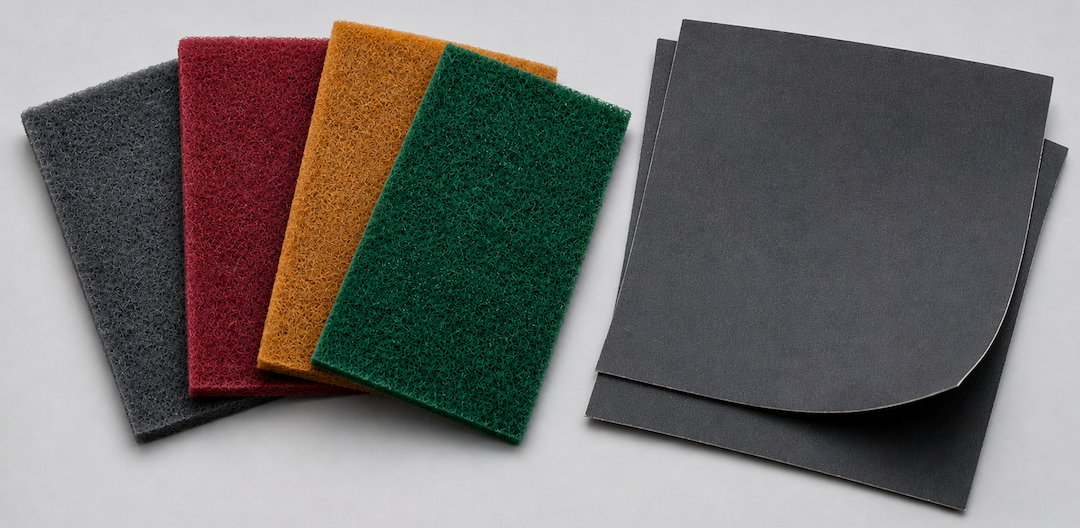
Yes — you can use Scotch-Brite pads in place of sandpaper for some prep and finishing steps in a touch-up repair. The pad colors correspond, roughly, to sandpaper grit ranges, so if you already have pads on hand you don't necessarily need to buy sandpaper for those steps. Two things to know before you do: Scotch-Brite pads cut differently than sandpaper, so the grit equivalents are a useful starting point rather than an exact match — and keep the pads dry when working on the paint, the same as we recommend for sandpaper.
Scotch-Brite Color to Sandpaper Grit
Scotch-Brite pads are color-coded by how aggressive they are. These are the colors that map to the grit ranges a touch-up repair actually uses:
Scotch-Brite color | Approximate sandpaper grit | Where it fits in a touch-up repair |
|---|---|---|
Green | ~180–320 | Heavier surface prep, oxidation, light rust cleanup |
Maroon (sometimes called red) | ~320–400 | General scuffing before primer or paint — the most commonly used automotive prep pad |
Gold | ~600–800 | Fine finishing and refining |
Gray | ~800–1000 | Ultra-fine scuffing, blending, and clear coat edge prep |
To find which grit a given step in your repair calls for, see What Sandpaper Grit Should I Use for Car Paint Repair? — then use the table above to match a pad to that grit.
Coarser, more aggressive Scotch-Brite colors exist (brown and black, in the 60–180 grit range), but heavy material removal like rust stripping is a job where sandpaper is the more reliable tool — see "How Scotch-Brite Compares to Sandpaper" below.
How Scotch-Brite Compares to Sandpaper
The grit equivalents above are approximate because Scotch-Brite pads and sandpaper cut differently. Sandpaper has a fixed abrasive on a backing, so a given grit produces a fairly consistent, uniform scratch pattern. Scotch-Brite is a nonwoven material — the abrasive runs all through the pad — which changes how it behaves:
It conforms to shapes. A pad flexes into curves, edges, and contours that a flat sheet of sandpaper can't reach evenly. This is the pad's real advantage.
It's pressure-sensitive. How hard you press changes the cut more than it does with sandpaper, so results depend more on technique.
It leaves a less uniform scratch. A gray pad rated "around 800–1000 grit" often leaves a more random, shallower scratch profile than actual P800 paper would. The pad scuffs the surface, but not in the even, predictable pattern paper produces.
The practical takeaway: for scuffing and adhesion prep on contoured surfaces, a pad is genuinely handy. For steps where an even, predictable scratch profile matters — leveling a surface before recoating, or heavy material removal — sandpaper at the specified grit is more reliable.
Use Scotch-Brite pads dry, not wet, on ScratchesHappen paint.
Our repair process is dry-only for abrasives on the paint, the same as we recommend for sandpaper. Scotch-Brite pads are often used wet in other contexts, but keep the pad dry when scuffing or smoothing the paint itself.
Metallic and Pearl Finishes
If your repair color is a metallic or pearl finish, lean toward the finer pads (gray rather than maroon) when scuffing. Metallic and pearl colors use translucent pigments, and a coarser scuff underneath can show through the finish in a way it wouldn't on a solid color. Going gentler with a finer pad — or with finer sandpaper — gives the translucent top coats a cleaner surface to sit on. Professional shops make the same adjustment, moving to finer abrasives around metallic and pearl work.
FAQ
Which Scotch-Brite color do I need for my repair
It depends on the step. First find the grit your repair step calls for in What Sandpaper Grit Should I Use for Car Paint Repair?, then match that grit to a pad color using the table above. Most touch-up prep lands on maroon (general scuffing) or gray (fine scuffing and blending).
Not on ScratchesHappen paint. Our repair process recommends dry use throughout, the same as our sandpaper guidance — keep the pad dry when scuffing or smoothing the paint itself.
Not on ScratchesHappen paint. Our repair process recommends dry use throughout, the same as our sandpaper guidance — keep the pad dry when scuffing or smoothing the paint itself.
Is a Scotch-Brite pad as good as sandpaper?
It's a different tool, not a better or worse one. Pads conform to curves and contours that flat sandpaper can't reach evenly, which makes them handy for scuffing shaped surfaces. Sandpaper produces a more uniform, predictable scratch, which matters more for leveling a surface or for heavier material removal. Use whichever fits the step.
What about removing rust?
For heavy rust removal, sandpaper at the grit specified in the sandpaper grit article is the better choice. The aggressive Scotch-Brite colors exist, but rust cleanup is exactly the kind of even, heavier material removal where sandpaper is more reliable than a conforming pad.
My repair is a metallic or pearl color — does that change which pad I use?
Yes — go finer. Use a gray pad rather than maroon when scuffing for a metallic or pearl repair. Those finishes use translucent pigments, and a coarser scuff underneath can telegraph through the paint.