

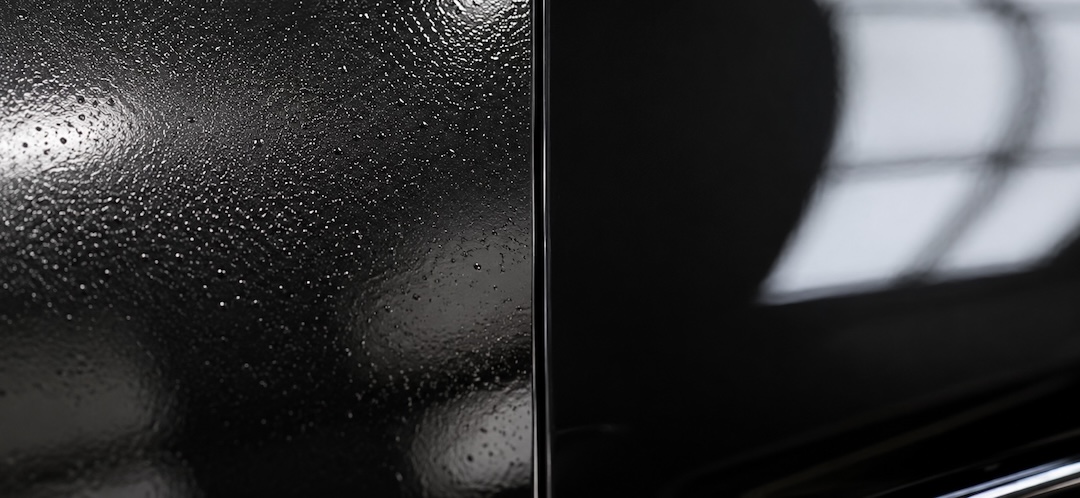
Bubbling in clear coat happens when solvents turn to gas before escaping through the curing film. The cause is almost always heat — a hot panel or coats applied too heavy. The fix: work in shade with a cool surface, and apply less heavy clear-coat passes with full flash time between each.
Quick Reference
What you saw at application | Likely cause | Fix |
|---|---|---|
Bubbles formed on contact with the panel, especially in direct sunlight | Hot surface | Move to shade, hand-check the panel before spraying, let the surface cool |
Bubbles formed in heavily-coated areas, sometimes with drips or sags nearby | Heavy coats (especially combined with heat) | Apply less heavy clear-coat passes with full flash time between each. Ensure panel is not hot |
What's Happening When Clear Coat Bubbles
Clear coat contains solvents that need to evaporate as the film cures. When the panel and the air are in the right temperature range, the solvents leave smoothly through the surface and the clear coat cures to an even, glossy finish.
When the surface is too hot, the solvents in the clear coat boil — they turn to gas faster than they can escape through the still-wet film, and they push up into bubbles that get trapped in the curing surface. Once the clear coat has cured around them, those bubbles are sealed gas pockets in the film.
Heavy coats make the problem worse: a thicker film traps more solvent under more material. Even at moderate temperatures, a heavy clear-coat pass can blister where solvents can't reach the surface in time.
Cause 1: Hot Surface
The temperature that matters for application is the surface temperature of the panel, not the air temperature around you. On a 75°F day, a panel sitting in direct sunlight can easily reach 110–140°F, and darker panels run hotter. When clear coat lands on a hot surface, the solvents in the coating boil on contact — they flash to gas faster than they can escape through the still-wet film, and they get trapped as bubbles in the curing surface.
The Fix
Move out of direct sunlight. Work in shade, indoors, or in a garage with the door open for ventilation.
Hand-check the surface. Touch the panel with the back of your hand. If you can hold it there comfortably, the surface temperature is fine. If you want to pull your hand away, the surface is too hot — wait for it to cool.
Cause 2: Heavy Coats
Heavy clear-coat passes trap solvent under a thicker film than it can escape through. The top of the coat starts to set while solvents below are still trying to evaporate, and the trapped gas forms bubbles in the curing layer. Heavy coats also produce a separate problem at the same time — they sag and run, especially when the panel is held vertically, because gravity pulls the extra clear-coat material down before it can cure.
The Fix
Apply less heavy clear-coat passes. The goal is uniform medium-to-full coverage in 2–3 passes rather than one heavy one.
Hold the can the right distance from the surface (typically 8–10 inches) for even coverage rather than pooled application.
Let each clear-coat pass flash off fully before the next. Touching the taped surface adjacent to the repair should feel firm to a light touch before the next pass goes on.
Watch for drips or sags as you spray. If clear-coat material starts running, you're applying too heavy and spraying strokes are too slow.
How to Fix Bubbled Clear Coat
The fix path is the same regardless of which cause produced the bubbling:
Sand back to a smooth, sound surface. Sand dry — see What Sandpaper Grit Should I Use for Car Paint Repair? for the right grit. Don't sand until the clear coat is dry so it doesn't clog up the sandpaper. Sand until the bubbled clear-coat layer is fully removed and the surface beneath is smooth.
Identify the cause using the Quick Reference table at the top of this article.
Address the cause — move to shade, let the surface cool, apply less heavy coats, or some combination depending on what produced the bubbling.
Reapply clear coat in medium coats (slightly heavier coverage than the base color) with 50% overlap. Maintain a 8-10 inch distance and consistent motion.
Important: Don't Try to Polish Bubbles Out
Polishing bubbled clear coat doesn't work. The bubbles are sealed gas pockets in the cured film, so polishing exposes hollow spots rather than smoothing the surface. The fix is always sanding back and reapplying.
FAQ
How is bubbling different from wrinkling?
Bubbles are raised, rounded blisters or pockets in the clear-coat surface — like trapped air under glass.
Wrinkling is creased, fabric-like ridges in the paint surface.
They have different mechanisms and different fixes — see Why Is My Paint Wrinkling? for the wrinkling diagnostic.
Could it be something other than heat?
Possibly. Bubbling could also come from moisture trapped in the surface, contamination, or incompatible coatings underneath — different mechanisms with different fixes. If conditions were cool when you painted and you applied medium-to-full coats, see Why Is My Paint Lifting or Bubbling? for the broader diagnostic.
Is it safe to use a spray can that's been sitting in a hot vehicle?
A spray can that's been in direct sun or a hot vehicle can build up dangerous internal pressure — most aerosol cans are rated for storage and use up to around 120°F (49°C). If a can feels very hot to the touch, let it cool to room temperature before using it. As a general rule, store cans between 50–90°F and out of direct sunlight.
Can I just sand the bubbles flat and keep going?
Yes — that's the standard fix. Sand back to a sound surface, address the cause (move to shade, let the surface cool, apply less heavy coats), then reapply clear coat in medium, consistent passes with full flash time between each.
If you sand back too far — through the paint layers — you'll need to reapply paint and then clear coat.
What if bubbling keeps happening after I cool everything down and apply less heavy coats?
Contact Support with photos in natural daylight, including a shot of where the bubbling occurred and the conditions you were painting in (temperature, surface type, time of day). There may be a substrate-specific or product-specific factor we can help diagnose.