
Yes — ScratchesHappen bottle paints can be sprayed through an airbrush, with some thinning required. This article documents our testing setup and recommended starting settings for primer, base color, and clear coat. The standard waterborne clear coat that ships in our kits doesn't spray well through an airbrush, so we substitute a solventborne alternative on request through Support.
Note that your mileage may vary.
Meaning: temperature, humidity, your gun's nozzle, and viscosity are all at work when airbrush spraying, and some adjustments from our settings may be required. We've successfully replicated our results many times, but that doesn't mean you won't have to do things a little differently. The test results below should be a good starting point, however.
Airbrush Spraying Primer (Waterborne)
The ScratchesHappen waterborne primer bottle that ships with all Preferred and Complete kits is well suited to airbrush spraying. Below are the details of our testing setup. Your settings and coverage may vary depending on altitude, temperature and humidity.
Altitude: Salt Lake City: 4550'
Temperature: 79 degrees Fahrenheit
Humidity: 37%
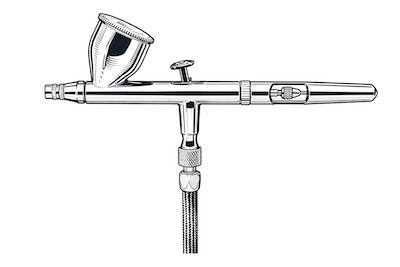
Airbrush Model: Iwata Eclipse HP-CS
Pressure: 30psi
Reduction: reduce the supplied primer in a 1:1 ratio with distilled water
For primer, we sprayed at a distance of 4-5 inches for a wider spray fan. We applied 2-3 coats, allowing each coat to flash off, which can be sped up by using an indirect fan blowing cool air across the painted surface. The flash time will vary based on your temperature and humidity. Use a test card for this, and give it at least 5-10 minutes to flash, then check it with your finger to see if it is still tacky. The cured primer is easily sanded with 600 or 1000 grit paper to promote adhesion before spraying base color.
Airbrush Spraying Base Color Paint (Waterborne)
All ScratchesHappen bottle paint is waterborne, and can be sprayed through an airbrush.
Altitude: Salt Lake City: 4550'
Temperature: 78 degrees Fahrenheit
Humidity: 44%
Airbrush Model: Iwata Eclipse HP-CS
Pressure: 10psi, but may vary depending on the reduction required for your paint (see #6 below)
Reduction: Start by thinning the waterborne paint with distilled water at a ratio of 1:0.25 paint:water. Note that different color paint has different viscosity, because the constituent toners that were used for your color's formula all have different viscosities. Some paints are thicker than others, so you may need to experiment with the reduction ratio. Yellows and reds need less dilution because they are generally thinner to begin with. We have reduced the paint with as little as 5% (20:1) and up to 50% water (1:1). Lower reduction ratios (thicker paint) require higher PSI to atomize through the airbrush.
For paint, we sprayed in a circular motion, and applied 3-4 coats, depending on the coverage of the color. Allow each coat to flash off. The flash time will vary based on your temperature and humidity. A fan blowing a gentle volume of air across the painted surface will speed the flash time. Use a test card for this, and give it at least 5-10 minutes to flash, then check it with your finger to see if it is still tacky.
Airbrush Spraying Clear Coat (Solventborne)
The standard clear coat bottle that ships with ScratchesHappen kits is waterborne, and does not spray well through an airbrush. After you order your kit, please contact Support with your order number and we'll substitute the waterborne clear coat with a solventborne alternative. If you've already received your kit with waterborne clear coat, we can exchange it for you.
Here are the settings for our solventborne clear coat spray test:
Altitude: Salt Lake City: 4550'
Temperature: 78 degrees Fahrenheit
Humidity: 42%
Airbrush Model: Iwata Eclipse HP-CS
Pressure: 20psi, but may vary depending on the reduction required for your paint (see #6 below)
Reduction: Start by thinning the solventborne clear coat with Xylene at a ratio of 2:1 Clear Coat:Xylene (a 33% reduction)
Spray distance: 6"
Spray each coat as a normal full clear coat, at a thickness so that it flows and is glossy. Wait 10 minutes between coats for the clear to flash. Typically, 3 coats is enough, but you can experiment with 2-4 coats.
We have found the clear sprays at a 25% reduction with Xylene (3:1 clear coat to Xylene). However, the 2:1 reduction sprayed better. Depending on your temperature and humidity, you may need to experiment with different reduction ratios.
FAQ
Can I use a different airbrush than the Iwata Eclipse HP-CS?
Yes. The Iwata Eclipse HP-CS is what we tested with and what our settings are based on, but ScratchesHappen paints will spray through other airbrushes too. You may need to adjust the reduction ratio (more water for paint, more Xylene for clear coat) or pressure based on your gun's nozzle size and design. Lower-quality or single-action airbrushes may need higher reduction to atomize properly.
Do I have to use distilled water for thinning?
Distilled water is what we recommend and test with. Tap water contains minerals that can affect waterborne paint chemistry and may clog your airbrush nozzle over time. Distilled water is inexpensive and widely available — worth using for both spray reliability and to extend your airbrush's life.
Can I airbrush ScratchesHappen paints without thinning?
No. Our bottle paint needs to be thinned before airbrushing so the paint can atomize properly through the smaller nozzle of an airbrush. Spraying unthinned paint will clog the airbrush and won't produce a usable spray pattern.
What if Xylene is hard to source where I live?
In California and some other regions, Xylene may be harder to find at retail due to local regulations on solvents. Xylene is still the better choice for airbrushing because it provides the optimal drying time for our solventborne clear coat. We haven't tested acetone or mineral spirits as substitutes, but you can test either of them — start with a small test batch and check the spray behavior and drying on a test card before using on your repair.
My paint is spitting or not atomizing well. What should I do?
Usually this means the paint is too thick for your nozzle and pressure combination. Try a higher reduction ratio first (more distilled water for the waterborne primer and base color, more Xylene for the solventborne clear coat). If the issue continues, increase your pressure slightly. Make sure your airbrush is clean — buildup in the nozzle from a previous session can also cause spitting.
What is Xylene, and where do I get it?
Xylene is a solvent commonly used to thin solventborne paints and clear coats. It's available at most hardware stores, automotive paint supply stores, and online retailers. Look for it labeled as Xylene or Xylol (same chemical, different naming).
Use proper ventilation, gloves, and eye protection when working with Xylene; follow the safety instructions on the container.