

In the photos below, the touch-up paint matches so closely that you can only see it where light catches the wet surface. That's the match working as it should — what we're cleaning up is the overpaint that extends past the chip itself.
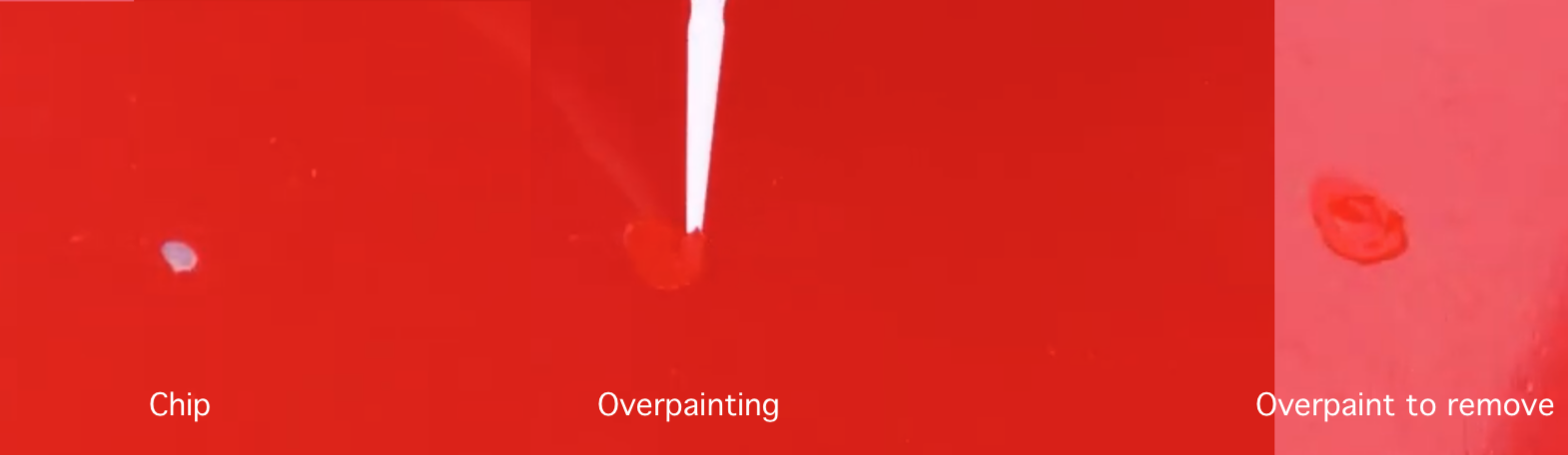
When fresh touch-up paint extends beyond the scratch or chip you're repairing, you can clean up the edges without removing the paint inside the damage — but the technique matters. Dab the excess away while it's still wet using a Q-tip, micro dabber, or soft cloth. If it's already dry, polish it off carefully with a damp dabber or a polish cloth wrapped around a pencil eraser. Never wet-sand bare waterborne paint — water sanding will remove it almost immediately.
Quick Reference
Situation: | Best technique | Tools |
|---|---|---|
Paint is still wet | Dab the excess away | Micro dabber, Q-tip, or soft cloth |
Paint has dried | Polish overpaint with a wet dabber | Micro dabber + water (or polish compound if water alone isn't enough) |
Paint has dried, fine control needed | Polish cloth on a pencil eraser | Polish cloth or thin eyeglass-cleaning cloth + pencil + water or polish compound |
Paint has dried, you have sandpaper handy | Don't wet-sand | Use one of the techniques above instead |
What You'll Need
ScratchesHappen micro dabbers, or Q-tips and a small piece of soft cloth
ScratchesHappen Polishing Compound (for dried overpaint that water can't remove)
A clean polish cloth, or a thin synthetic eyeglass-cleaning cloth
A pencil with an unused eraser
Clean water
If the Paint Is Still Wet
This is the easiest case — handle it before the paint dries.
Use a micro dabber, Q-tip, or small piece of soft cloth.
Wiping can spread paint into the scratch. Dab straight down and lift away.
Before the paint dries. If overpaint still extends past the scratch, dab again.
If the Paint Has Already Dried
You'll need to remove paint precisely without affecting the paint that's filling the scratch. Two techniques work well; choose based on how much control you need.
Technique 1 — Micro Dabber + Water (or Polish Compound)
Apply gentle pressure to the overpaint. Because the paint is waterborne, water alone is often enough.
Check the paint you're removing as you go.
Switch to a small amount of ScratchesHappen Polishing Compound on the dabber and rub the edge of the overpaint carefully.
So the surface stays visible.
Continued rubbing will start to remove paint from inside the scratch.
Technique 2 — Polish Cloth on a Pencil Eraser
This gives you the finest control because the cloth conforms to the eraser tip while the eraser keeps consistent pressure.
Around the eraser end of a pencil. The cloth gives you a soft, pliable rubbing tip.
Ensure it's not soaking wet.
Work in small areas.
As it picks up paint, so you're always working with a clean surface.
Important: Don't Polish Bare Paint
Whether you use water, alcohol, or polish compound, polishing or wiping freshly applied paint will remove it — including the paint inside the scratch.
This is normal: uncoated paint is fragile until clear coat is applied. Keep your edge cleanup focused on the overpaint outside the scratch, and leave the paint inside the scratch alone.
See Is It Necessary to Use Clear Coat? for why clear coat matters.
If the Repair Itself Is Uneven
Edge cleanup can only address overpaint outside the scratch — it can't fix an uneven paint surface inside the repair. If the paint inside the scratch is uneven, the repair needs to be redone, following the full instructions for your kit. The instructions walk through surface prep, paint applied in thin coats, drying time, and clear coat in the right order. Trying to fix an uneven repair ad hoc usually compounds the problem.
Find the right instructions for your kit at Where Can I Find Your Instructions?. For more on what causes uneven finishes, see My Touch Up Paint Job Does Not Look Very Smooth.
FAQ
Can I wet-sand the dried paint at the edges?
No. ScratchesHappen paint is waterborne, and wet sanding will remove it almost immediately — including the paint inside the scratch. Use one of the dabber or polish-cloth techniques instead.
How do I tell whether the paint is "wet" or "dried" for cleanup purposes?
Treat the paint as wet if it still has a visible sheen or transfers to a clean dabber when touched. Treat it as dried once the surface is matte and the dabber comes away clean. Drying time depends on coat thickness, temperature, and humidity — see Drying Time Summary for the timing on each stage of dry and cure.
Why does the paint come off when I polish it with water?
Because uncoated waterborne paint is fragile. Until clear coat is applied, water, alcohol, and polish compound will all remove fresh paint. That same fragility is what lets you remove only the overpaint at the edges if you're careful.
Should I use water or polish compound first?
Try water first — it's gentler. Switch to polish compound only if water doesn't lift the overpaint.
How much pressure should I use?
Light, gentle pressure. Let the water or polish compound do the work, not the rubbing. Heavy pressure increases the chance you'll remove paint from inside the scratch along with the overpaint. If light pressure isn't lifting the paint, switch from water to polish compound rather than pressing harder.
Does the polish compound technique still work on overpaint with no clear coat that's been dry for days?
Generally yes, but cleanup is easier the sooner you do it. Recently dried overpaint comes off with light pressure and water; overpaint that's had longer to cure typically needs polish compound and more patient effort. If you can address bare overpaint (no clear coat) within the first day or two after painting, the work is much faster.
What's the difference between a dabber and the polish-cloth-on-pencil method?
A dabber is faster and works well for most cleanup. The polish-cloth-on-pencil method is finer-grained — useful for small or awkward areas where you need maximum precision.
What if I accidentally remove paint from inside the scratch?
Reapply paint to the scratch in 2–3 thin coats, let it dry, then continue with clear coat.